
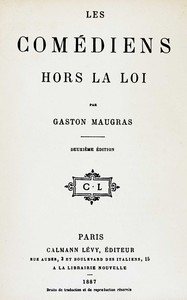
Les comédiens hors la loi by Gaston Maugras
(4 User reviews)
432
Maugras, Gaston, 1850-1927
French
"Les comédiens hors la loi" by Gaston Maugras is a historical account written in the late 19th century. It investigates why actors were long treated as socially and religiously suspect, tracing their status from sacred ritual origins through Roman infamy, Christian condemnation, medieval liturgy, and modern rehabilitation. Drawing on councils, laws...
church–state relations, and shifting cultural norms. The opening of the work frames the subject with the 1884 Saint‑Roch mass honoring Corneille, contrasted with the punishment of a Paris curé for a similar service in 1763, and cites a lively press debate to show how misunderstood the Church’s treatment of actors remains. The author sets out his plan to survey actors’ legal and religious status from Greece and Rome through the Middle Ages to the eighteenth and nineteenth centuries, listing key sources. He first shows the stage arising from religious rites—honored in Greece—then becoming infamous at Rome as performances passed to slaves and to mass entertainments of the circus, mimes, and pantomimes, despite their continuing pagan-sacral character and imperial favor. He then explains the early Church’s rationale for condemning spectacles and denying sacraments to performers unless they quit the stage, notes emperors’ mixed measures (including Justinian’s permission for converts to leave the profession), and describes the decline of theaters in the West under barbarian invasions while they endured in the East. Finally, the narrative sketches the medieval revival of drama within churches—liturgical plays for major feasts alongside the unruly Feast of Fools—before the excerpt breaks off. (This is an automatically generated summary.)
Mark Johnson
3 months agoI was skeptical at first, but it serves as a poignant reminder of the human condition. Thanks for making this available.
Richard Hernandez
5 months agoI almost skipped this one, yet the plot twists are genuinely surprising without feeling cheap or forced. I’ll definitely revisit this in the future.
Amanda Hill
3 weeks agoSimply put, the structure allows easy navigation and qucik referencing. Highly recommended for everyone.
There are no comments for this eBook.


Aiden Sanchez
4 months agoThis came highly recommended and the content remains relevant throughout without filler. I learned so much from this.